

What a chain needs
- A finality rule Ethereum can check: a canonical bridge, a light client, or accumulated proof of work.
- A way to enforce payment rules: a smart-contract router, or, for UTXO chains, a payment format that a proof can bind to the statement.
- Infrastructure: public RPCs with archive history and a published contract registry.
The verifier (Ethereum)
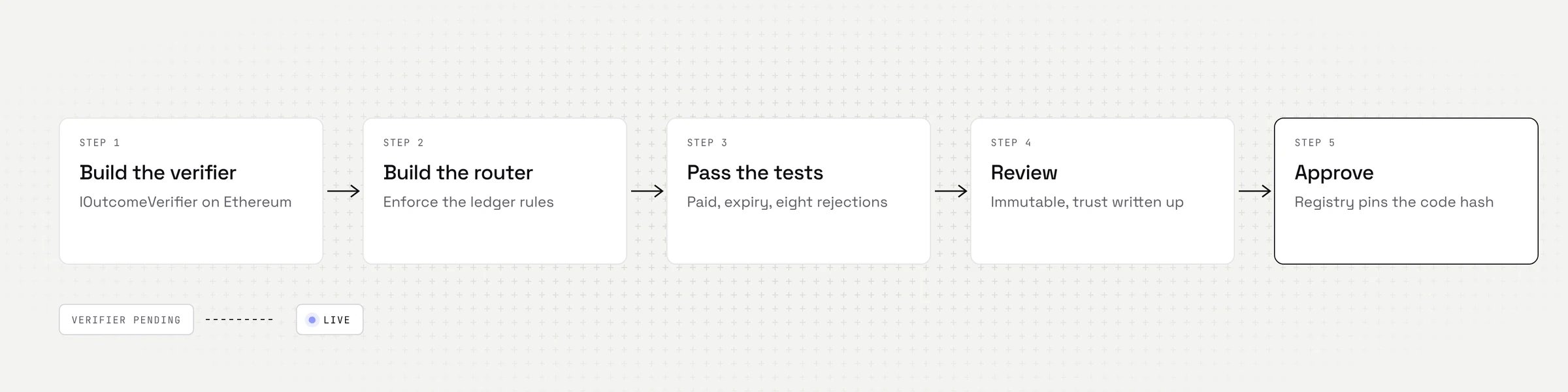
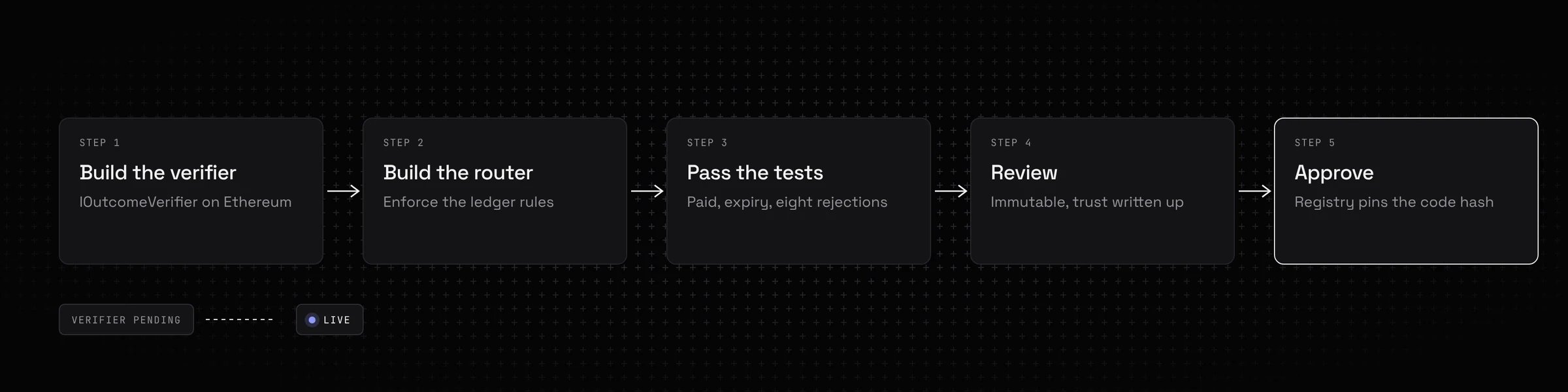
ImplementIOutcomeVerifier:
acceptsruns at listing. Reject any terms your destination can’t encode or enforce.verifyreturns true only when the destination recorded Paid for that statement.verifyExpiredreturns true only when it recorded ExpiredUnpaid.- All three must be
view, and the contract must be immutable: no proxy, no owner, no settable fields. The registry pins the code hash but can’t detect a proxy, so reviewers reject one. - A recorded outcome must stay true forever.
The destination ledger
Whatever runs on the destination chain must enforce, per statement:- One terminal outcome. Paid or ExpiredUnpaid, never both, never changed.
- Payment only before the deadline, only from the matched filler, only in the requested asset and exact amount, only to the requested recipient, recorded atomically with the transfer.
- Expiry by anyone at or after the deadline while still pending.
- Safe repeated delivery, and authentication of the specific application and ledger the outcome came from.
quoteStatement as a cross-implementation test vector. See Statement encoding.
Testing
A route must complete, without changingsrc/Ambi.sol:
- a paid fill, end to end;
- an expired-unpaid refund, end to end;
- rejection of: the wrong statement, another order’s outcome, a conflicting outcome, a late payment, the wrong payer, the wrong amount, the wrong recipient, and a forged sender.
Approval
1
Apply
Use List a chain on the Chains page, or
POST /chains/applications.2
Review
Code review of both contracts, a check that the verifier is immutable, the test results, and a written statement of what the route trusts.
3
Approve
The registry owner calls
approve(inbox, label), pinning its code hash. The chain goes live in the app and API.