


How Ambi works
The four steps of every trade, and what crosses chains.
Quickstart
Post your first offer, or fill one.
Fill offers
Hold inventory on other chains. Get paid in Ethereum assets.
Build on Ambi
Contracts, API and the statement spec.
One trade, end to end
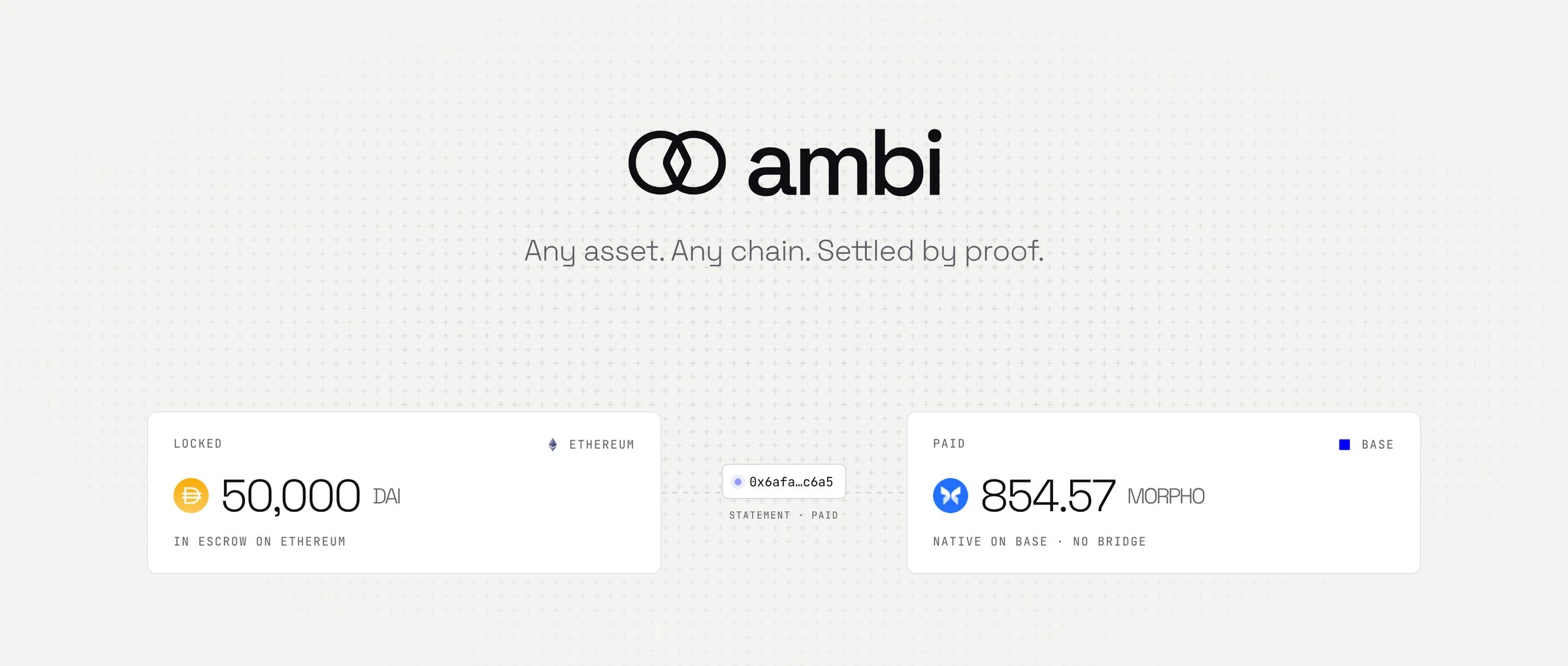
A maker wants 854.57 MORPHO on Base and offers 50,000 DAI on Ethereum for it.1
List
The maker escrows 50,000 DAI in the Ambi market and names the terms: 854.57 MORPHO, to this address on Base, within the hour, judged by the Base verifier.
2
Match
Fillers request the order and post the bond the maker asked for. The maker picks one. From here the maker can go offline.
3
Pay
The filler sends 854.57 MORPHO through the Ambi router on Base. The router records Paid in the same transaction and sends that outcome home over Base’s own bridge.
4
Collect
About 30 minutes later, once nobody has disputed the payment, the filler is credited 49,850 DAI, the escrow minus the 0.30% fee, plus their bond. Had nobody paid in time, the maker would have been credited instead.
See it work
A real order page: request, match, pay, release
What you get
No bridge risk
No shared pool and no minted IOUs. Each trade’s risk is that trade’s alone.
Any asset
Lock ETH or any ERC-20. Ask for any asset a live route can deliver.
Peer-to-peer prices
Makers set the rate. Fillers compete to take it.