

Fast settlement on rollup routes
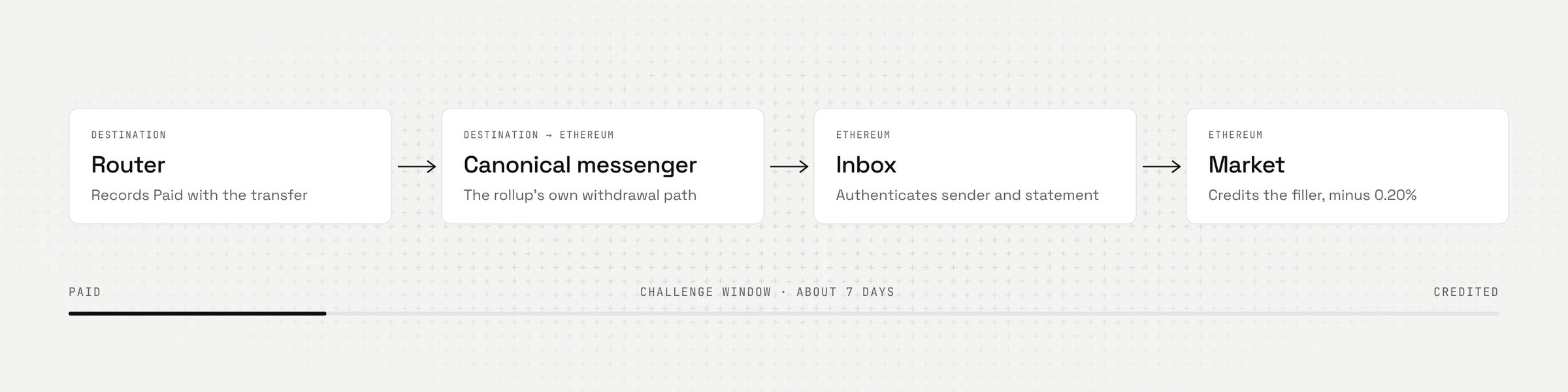
A rollup’s own bridge takes about a week to carry a message to Ethereum. Ambi doesn’t make fillers wait for it. The route’s inbox settles on a bonded claim instead, and keeps the bridge as the final word.1
Claim
Once the router records the outcome, anyone calls
claimPaid(id) or claimExpired(id) on the inbox and posts the claim bond. Relayers do this automatically within seconds of the payment.2
Window
The claim stands for the route’s dispute window, 30 minutes by default. Anyone who sees the claim contradict the destination chain disputes it with the dispute bond.
3
Settle
If nobody disputes, the window closes and the market settles:
fulfill credits the filler, or refundExpired credits the maker.
Each is fixed in the inbox’s code when it is deployed, so the registry’s pinned code hash covers them too. The window can be anywhere from 5 minutes to 1 day.
The bridge behind every claim
- Base (OP Stack)
- Arbitrum One
- The router calls
L2CrossDomainMessenger.sendMessage(inbox, record(statement, outcome), 150000). - A dispute game resolves an output root covering that block.
- Anyone proves the withdrawal on the
OptimismPortal, waits the proof maturity delay (7 days on Base), and finalizes it. - The L1 messenger calls
inbox.record.
HyperEVM to Elysium
On the Elysium market, escrow sits on Elysium and fillers pay on HyperEVM, Elysium’s parent chain. Messages from a parent chain to its rollup skip the withdrawal challenge period entirely, so this route needs no claims.- The router on HyperEVM creates a retryable ticket through Elysium’s Inbox, carrying
record(statement, outcome)to the Ambi inbox on Elysium. - Elysium executes the ticket within minutes. The inbox accepts it only from the router’s aliased address.
- Anyone calls
fulfillorrefundExpiredon the Elysium market.
quote gives the amount. If a ticket doesn’t execute on its own, anyone can redeem it on Elysium, and the filler can always resend the outcome. The inbox ignores duplicates.
How long it takes
A recorded outcome never expires. If no one settles for a month, the credit is still there when someone does.

Who settles
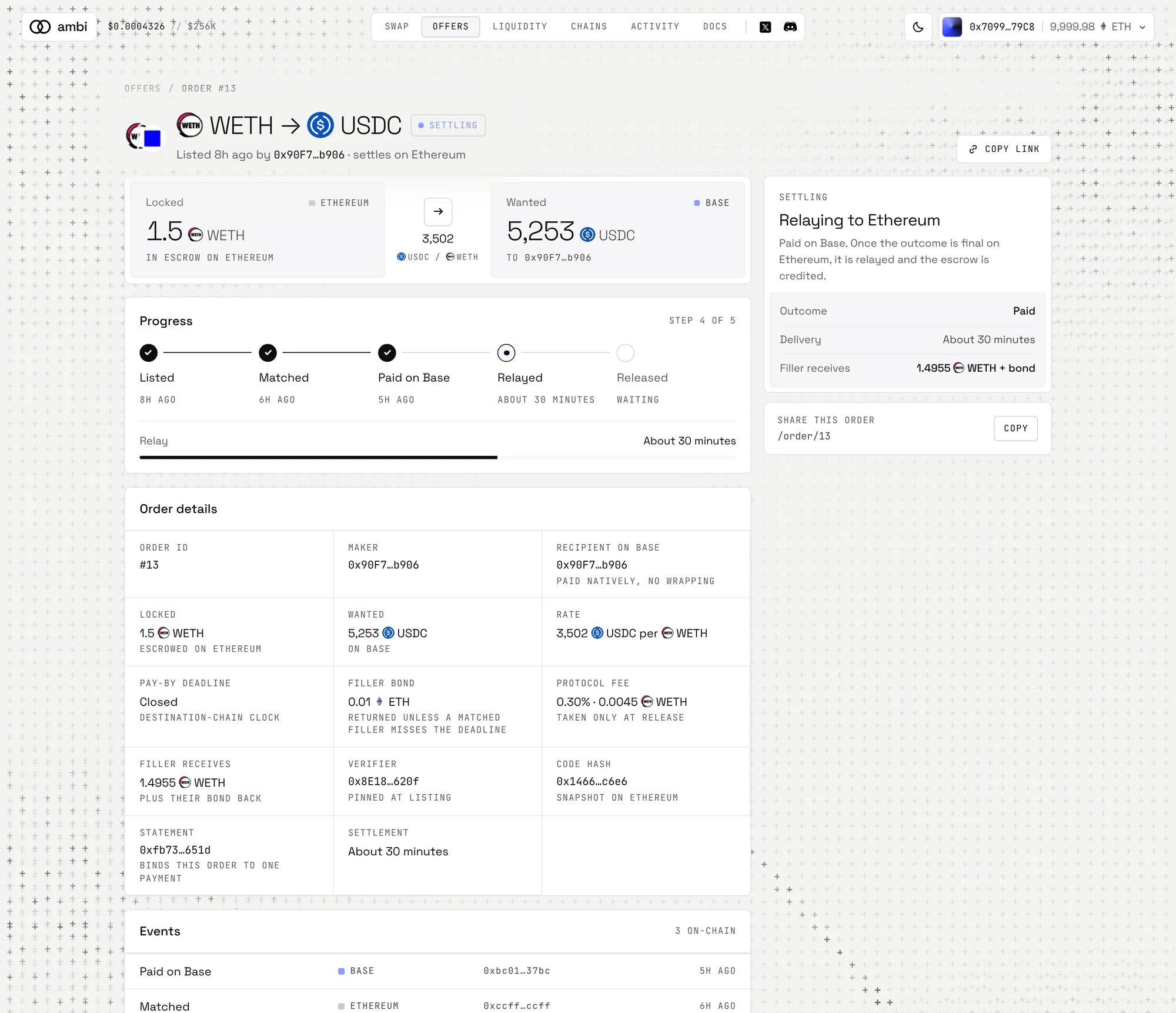
Anyone, and it makes no difference who.fulfill always credits the matched filler, or the receive address they named, and refundExpired always credits the maker. See Relayers.